



The Carolinas region Consumer Price Index Summary according to the United States Department of Labor, U.S. Bureau of Labor Statistics

CONSUMER PRICE INDEXES by U.S. BUREAU OF LABOR STATISTICS
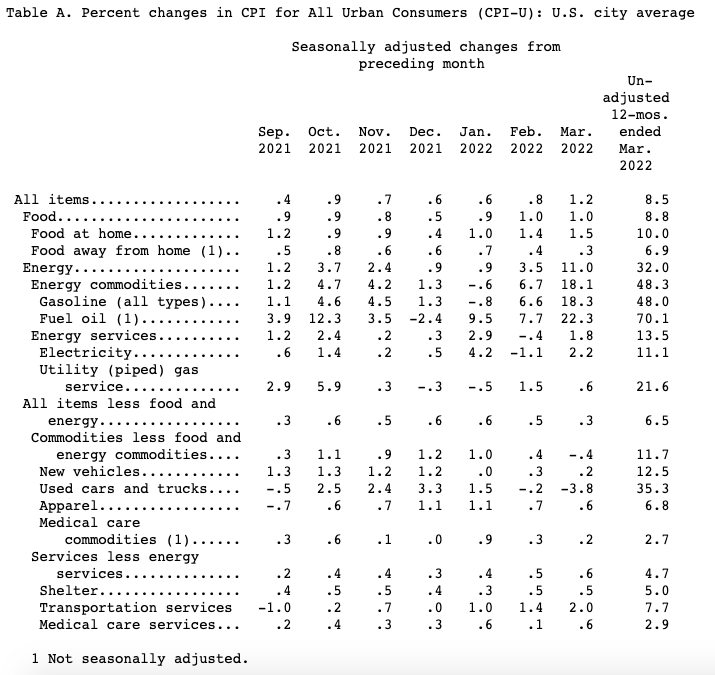
The Consumer Price Index for All Urban Consumers (CPI-U) increased 1.2 percent in March on a seasonally adjusted basis after rising 0.8 percent in February, the U.S. Bureau of Labor Statistics reported today. Over the last 12 months, the all items index increased 8.5 percent before seasonal adjustment.Increases in the indexes for gasoline, shelter, and food were the largest contributors to the seasonally adjusted all items increase. The gasoline index rose 18.3 percent in March and accounted for over half of the all items monthly increase; other energy component indexes also increased. The food index rose 1.0 percent and the food at home index rose 1.5 percent. The index for all items less food and energy rose 0.3 percent in March following a 0.5-percent increase the prior month. The shelter index was by far the biggest factor in the increase, with a broad set of other indexes also contributing, including those for airline fares, household furnishings and operations, medical care, and motor vehicle insurance. In contrast, the index for used cars and trucks fell 3.8 percent over the month.The all items index continued to accelerate, rising 8.5 percent for the 12months ending March, the largest 12-month increase since the period ending December 1981. The all items less food and energy index rose 6.5 percent, the largest 12-month change since the period ending August 1982. The energy index rose 32.0 percent over the last year, and the food index increased 8.8 percent, the largest 12-month increase since the period ending May 1981.
Food prices in The Carolinas
The food index increased 1.0 percent in March as the food at home index increased 1.5 percent over the month. All six major grocery store food group indexes increased in March. The largest increase was for other food at home which increased 2.0 percent over the month. The index for fruits and vegetables rose 1.5 percent following a 2.3-percent increase in February. The index for meats, poultry, fish, and eggs increased 1.0 percent in March, while the index for cereals and bakery products rose 1.5 percent and the index for nonalcoholic beverages increased 1.2 percent over the month. The dairy and related products index also increased 1.2 percent in March.The food away from home index rose 0.3 percent in March, a smaller increase than in recent months. The index for full service meals rose 0.7 percent over the month, in contrast to the index for limited service meals which declined 0.2 percent, its first decrease since October 2018. The food at home index rose 10.0 percent over the last 12 months, the largest 12-month increase since the period ending March 1981.
The index for meats, poultry, fish, and eggs increased 13.7 percent over the last year as the index for beef rose 16.0 percent.
The other major grocery store food group indexes also rose over the past year, with increases ranging from 7.0 percent (dairy and related products) to 10.3 percent(other food at home). The index for food away from home rose 6.9 percent over the last year, the largest12-month increase since December 1981. The index for full service meals rose8.0 percent over the last 12 months, and the index for limited service meals rose7.2 percent. The index for food at employee sites and schools, in contrast, declined30.5 percent over the past 12 months, reflecting widespread free lunch programs.
Energy costs in The Carolinas
The energy index rose 11.0 percent in March following a 3.5-percent increase inFebruary. The gasoline index rose sharply in March, increasing 18.3 percent after rising6.6 percent in February. (Before seasonal adjustment, gasoline prices rose 19.8 percent in March.) The index for electricity increased 2.2 percent in March, while the index for natural gas rose 0.6 percent over the month.The energy index rose 32.0 percent over the past 12 months with all major energy component indexes increasing. The index for gasoline rose 48.0 percent over the last year and the index for natural gas rose 21.6 percent. The index for electricity rose11.1 percent for the 12 months ending March.
The food at home index rose 10.0 percent over the last 12 months, the largest 12-month increase since the period ending March 1981.
The index for all items less food and energy rose 0.3 percent in March. The shelter index increased 0.5 percent in March and accounted for nearly two thirds of the monthly increase in the all items less food and energy index.
Rent index in The Carolinas
The rent index increased 0.4 percent in March as did the owners’ equivalent rent index. The index for lodging away from home rose3.3 percent over the month after rising 2.2 percent in February.The index for airline fares rose 10.7 percent in March, after rising 5.2 percent in February. The household furnishings and operations index rose 1.0 percent over the month, the eighth consecutive increase in that index.
The index for motor vehicle insurance increased 0.7 percent in March, and the index for apparel rose 0.6 percent in March.
The index for recreation increased 0.2 percent, and the index for personal care increased 0.5 percent over the month.
The medical care price index in The Carolinas
The medical care index increased 0.5 percent in March. The index for physicians’ services also increased 0.5 percent over the month, while the index for hospital services rose 0.4 percent. The index for prescription drugs fell 0.2 percent in March, after rising 0.3 percent in February.
New and used vehicles prices
The index for new vehicles increased 0.2 percent in March after rising 0.3 percent the previous month. The index for used cars and trucks fell 3.8 percent in March, its second consecutive monthly decline after a series of large increases.
The index for communication was also among those few indexes which declined over the month, falling 0.5 percent.The index for all items less food and energy rose 6.5 percent over the past 12 months, with virtually all of its major component indexes rising over the span.
Shelter Index
The shelter index rose 5.0 percent over the last 12 months, its largest 12-month increase since May1991. The index for household furnishings and operations increased 10.1 percent over the past year, its largest 12-month increase since the period ending July 1975.
_______________
Related News