


Elon Musk's Bold Prediction: The End of Retirement Savings in an Era of AI Abundance

If you came here from our YouTube short and have the need to DEMAND more answers, we feel the same. Please comment on YouTube as we work on getting more answers.
SUMMARY of: "Elon Musk's Bold Prediction: The End of Retirement Savings in an Era of AI Abundance"
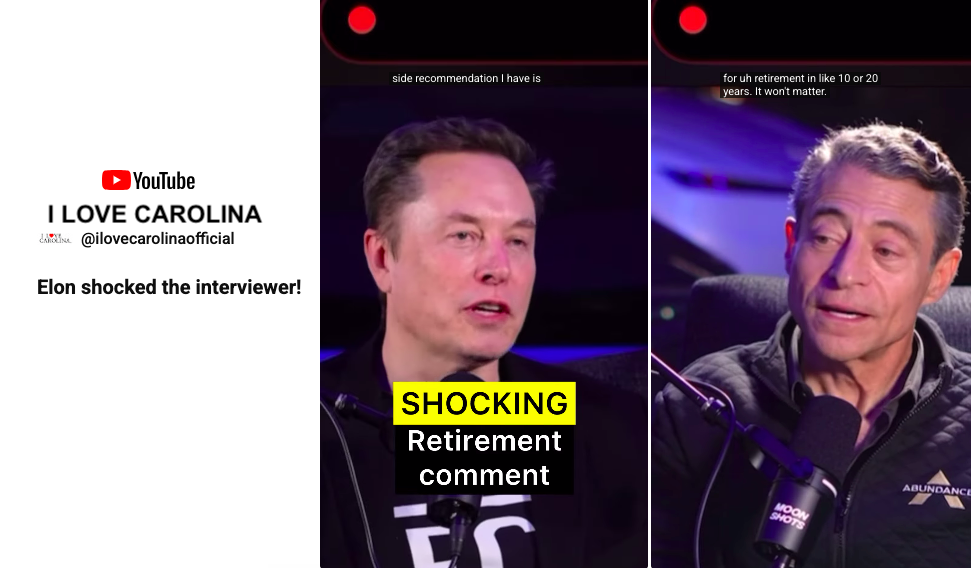
On January 6, 2026, during the "Moonshots with Peter Diamandis" podcast, Elon Musk boldly declared that saving for retirement could soon become pointless. He stated: "One side recommendation I have is: Don't worry about squirreling money away for retirement in 10 or 20 years. It won't matter." Adding, "If any of the things that we've said are true, saving for retirement will be irrelevant."
Musk's vision rests on explosive progress in AI, robotics, and clean energy leading to extreme abundance, a "Star Trek-style" post-work era with "universal high income," where goods, services, healthcare, and education are so plentiful that money loses much of its importance and work becomes optional.
Financial experts and economists sharply criticize this as dangerously detached advice. With current realities—including high inflation, rising healthcare and living costs, inadequate savings for most Americans, potential AI-driven job losses, and uncertain timelines—they warn that stopping retirement planning now risks severe financial hardship, especially since abundance (if it arrives) may not be equitable or timely. Critics note Musk's immense wealth ($700+ billion) insulates him from everyday pressures, making his optimism feel reckless for the average person.
FULL ARTICLE
In a world grappling with economic uncertainty, inflation, and the ever-looming specter of insufficient retirement funds, Elon Musk's latest pronouncement might sound like a radical departure from conventional wisdom. During a January 6, 2026, episode of the "Moonshots with Peter Diamandis" podcast, the Tesla and SpaceX CEO suggested that traditional retirement planning could soon become obsolete.
"One side recommendation I have is: Don't worry about squirreling money away for retirement in 10 or 20 years," Musk stated. "It won't matter."
This comment, delivered amid a three-hour discussion on artificial general intelligence (AGI), robotics, and sustainable energy, ties into Musk's overarching vision of a future defined by unprecedented abundance—where AI and technology eliminate scarcity, making concepts like saving for old age "irrelevant."
Musk's remarks weren't isolated quips but part of a broader narrative about humanity's trajectory. Co-hosted by futurist Peter Diamandis and investor Dave Blundin at Tesla's Giga Texas facility, the conversation delved into themes of optimism and radical transformation. Diamandis, founder of the XPRIZE Foundation, and Blundin explored topics like AGI timelines, energy constraints, and humanoid robots. Musk painted a picture of a "Star Trek-style future" where AI handles most labor, freeing humans from mandatory work.
He argued that advancements in AI compute, robotics, and clean energy would lead to "universal high income"—a concept he prefers over universal basic income (UBI), implying not just subsistence but prosperity for all.
When pressed on how this abundance would materialize, Musk hesitated on the role of government redistribution. In one exchange, Diamandis asked if corporate profits from AI-driven efficiency would be taxed and redistributed. Musk pivoted, avoiding direct endorsement of government involvement:
"If any of the things that we've said are true, saving for retirement will be irrelevant."
This reluctance highlights Musk's libertarian leanings, favoring market-driven solutions over policy interventions. Instead, he likened the future to a world where necessities are so plentiful that money loses its grip:
"The cost of intelligence has gone to nothing," he noted in related discussions, predicting AGI by 2026.
Musk expanded on the mechanics of this shift. He envisioned AI and robots producing goods and services at negligible costs, eliminating poverty and making work optional.
"We're heading toward a post-work society," he said in a clip about education and skills, advising that while college might still hold social value, many learned abilities could become unnecessary in an AI-dominated economy.
Drawing analogies to everyday choices—like growing your own vegetables versus buying them—Musk suggested that in abundance, people could pursue passions without financial pressure.
"There will be a lot of robots. Way more robots than people," he remarked, emphasizing how humanoid bots like Tesla's Optimus would amplify productivity.
Energy was another pillar of his argument. Musk discussed scaling solar-powered AI satellites for compute, predicting that space-based systems would outpace Earth-bound ones in efficiency within four to five years. This ties into his broader warnings about national solvency:
"If the country goes insolvent... there's no money left for anything," he said, stressing the need for fiscal responsibility to enable such innovations.
In Musk's view, abundance isn't just technological—it's economic, requiring nations to invest in AI infrastructure to avoid bankruptcy.
Echoes from Musk's Broader Philosophy
These ideas aren't new for Musk; they've echoed in his public statements for years. He has long championed expansionist philosophies, framing humanity's future as one of growth or decline. He critiques "extinctionist" views like degrowth economics, advocating for pro-natalism and technological acceleration to counter collapsing birth rates. In the podcast, this ties back to retirement: without expansion, societies contract, making savings futile; with it, abundance renders them unnecessary.
Musk's optimism extends to Tesla's role. He praised the company's 2025 achievements in energy storage and AI, noting that Tesla remains the leader in real-world AI applications. He contrasted Tesla's vision-based self-driving approach with competitors, highlighting scalable, general solutions over specialized ones.
The Tension Between Vision and Reality
While Musk's vision is compelling, it stands in stark contrast to today's financial realities. Many Americans currently face serious challenges with retirement security—rising costs for housing, healthcare, and long-term care, coupled with uncertainties around Social Security and inadequate personal savings. Financial planners and economists caution that Musk's timeline for abundance remains speculative, and even if AGI arrives in the coming years, the transition could be turbulent, with significant disruption to jobs and economic structures long before any era of universal high income materializes.
Musk himself frames his advice as conditional: "If any of the things that we've said are true…" Yet the boldness of his statement—that saving for retirement in 10 or 20 years may prove pointless—has sparked widespread discussion, challenging people to rethink long-held assumptions about work, money, and the future.
Whether Musk's prediction proves prophetic or overly optimistic, it reflects his consistent belief that humanity stands on the cusp of the most transformative technological leap in history—one that could render many of today's economic worries obsolete.
For now, the message is clear: in Elon Musk's view of tomorrow, the old rules of saving, working, and retiring may no longer apply. The question is not whether abundance is possible—but how quickly society can reach it, and what happens along the way.
Expert Counterarguments: Why Musk's Advice Faces Pushback
Musk's optimistic forecast has drawn sharp criticism from financial experts, economists, and commentators who argue that his advice is not only premature but potentially harmful. They emphasize that while technological abundance may be a long-term possibility, dismissing retirement savings ignores immediate economic pressures and the risks of an uneven transition to an AI-driven world.
One key critique is that Musk's perspective is detached from the realities faced by most people. As the world's richest individual, worth an estimated $700 billion, Musk operates in a financial realm far removed from the average American struggling with inflation, stagnant wages, and mounting debt. Critics point out that his reluctance to endorse government redistribution—such as taxing AI profits for universal income—leaves unanswered how abundance would equitably reach the masses, potentially exacerbating inequality during the shift.
Financial advisors warn that following Musk's advice could lead to disaster. Experts have described the statement as "dangerous" for seniors and retirees reliant on Social Security, Medicare, pensions, and personal savings. They argue that billionaires like Musk don't face the same retirement pressures, and his utopian vision overlooks persistent issues like healthcare costs and longer life expectancies, which demand robust savings today.
Economists highlight the ongoing affordability crisis as a direct counterpoint. Years of high inflation, elevated interest rates, and weak wage growth have left millions worried about basic needs, let alone retirement. Research shows Americans aren't saving nearly enough for comfortable retirements, and Musk's comments could discourage prudent planning, leaving people short if his predictions don't materialize quickly. One commentator called it "the worst advice you will read today," stressing that against a backdrop of economic hardship, such blue-sky thinking feels like wishful—or even reckless—guidance.
Even Musk acknowledges potential bumps in the road, including social unrest and a loss of purpose in a post-work society. Critics amplify this, noting that AI-driven job displacement could widen gaps before abundance arrives, making savings more critical as a buffer during disruption. Overall, experts urge caution: while innovation is exciting, betting one's financial future on unproven timelines is a high-stakes gamble.
Whether Musk's prediction proves prophetic or overly optimistic, it reflects his consistent belief that humanity stands on the cusp of the most transformative technological leap in history—one that could render many of today's economic worries obsolete.
For now, the message is clear: in Elon Musk's view of tomorrow, the old rules of saving, working, and retiring may no longer apply. The question is not whether abundance is possible—but how quickly society can reach it, and what happens along the way.
Article Summary:
In a January 2026 podcast with Peter Diamandis, Elon Musk predicted that rapid advances in AI, robotics, and energy will soon create such extreme abundance that traditional retirement savings will become irrelevant within 10–20 years. He advised against "squirreling money away" for retirement, envisioning a post-work, "Star Trek-style" future with universal high income where work is optional and necessities are nearly free. Financial experts strongly disagree, calling the advice dangerous and detached from today’s realities—rising living costs, inadequate savings, job displacement risks, and uncertain timelines mean most people should continue planning responsibly for retirement.
What AGI means?
Artificial General Intelligence (Technology/AI) In technology, AGI stands for Artificial General Intelligence, a hypothetical form of AI that aims to replicate human-level cognitive abilities. Definition: Unlike current "narrow AI" (which excels at specific tasks like chess or language translation), AGI would have the ability to understand, learn, and apply knowledge across any intellectual task that a human can perform. Key Traits: It is characterized by generalization ability (transferring skills between different domains), common sense reasoning, and the ability to learn new skills without being specifically programmed for them. Current Status: As of 2026, true AGI does not yet exist and remains a major research goal for companies like OpenAI, Google DeepMind, and Meta. Levels: Some researchers use "levels of AGI" to track progress, ranging from "Emergent" (like current large language models) to "Superhuman" capabilities.
Related News